


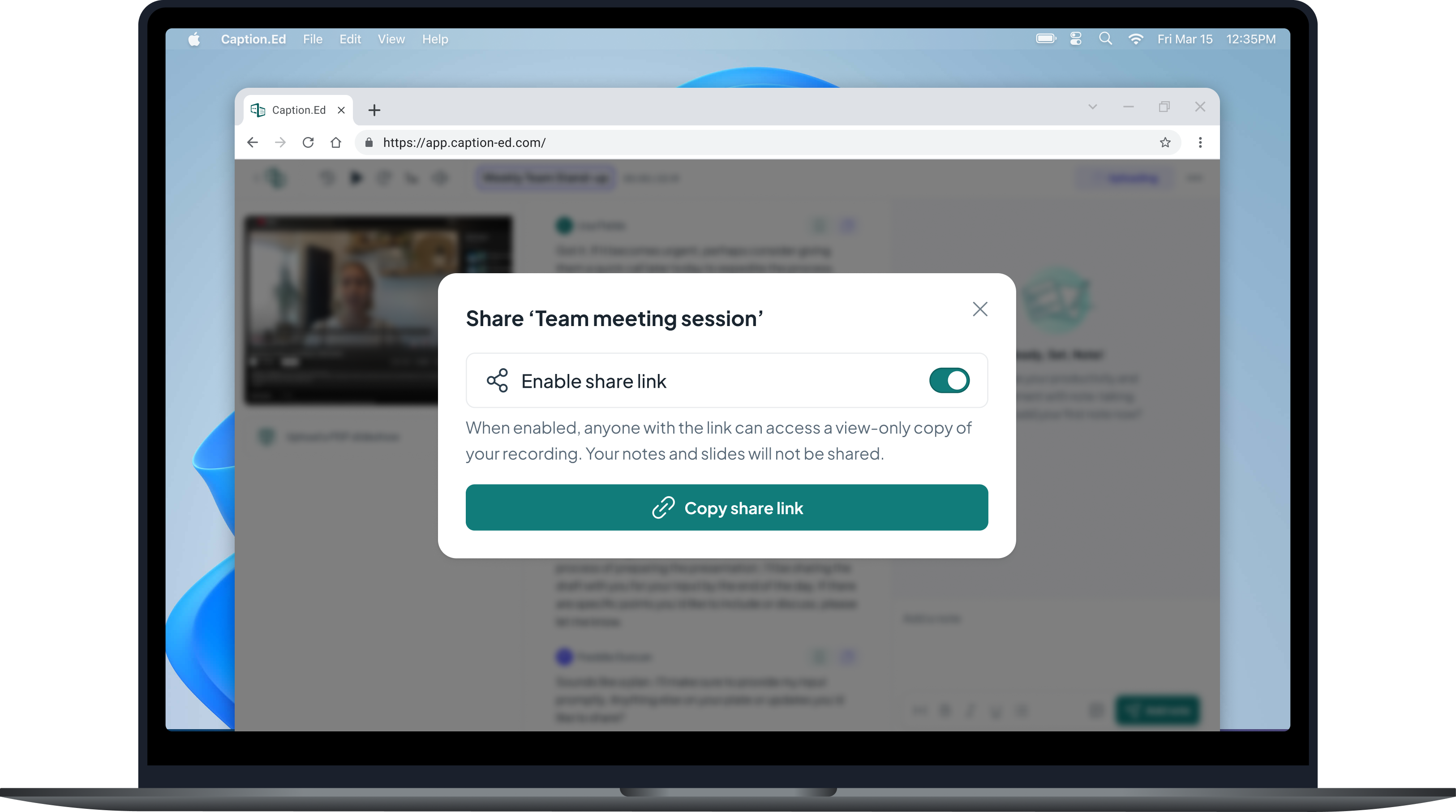


Driving inclusion for students at scale with Caption.Ed
Discover how the Disability Services team at the University of Bristol is ensuring every student has equal access to learning, without relying on external funding.


The University of Bristol’s Disability Services team supports thousands of students every year — ensuring that everyone, regardless of background or funding status, has access to the tools they need to succeed.
When Elizabeth Back, Former Disability Services Manager, recognised that international and non-DSA (Disabled Students’ Allowance) funded students weren’t receiving the same level of study support as their peers, she knew something had to change.
“As Disability Services Manager, I had responsibility for the operational management of disability support for students at the University of Bristol,” Elizabeth explained. “It’s important to us that disabled students who aren’t eligible for external funds, like Disabled Students’ Allowance, can access equivalent support. Caption.Ed has been an important part of our offer for international and other non-DSA funded students.”
Addressing the accessibility gap for non-DSA students
Like many universities, Bristol offers lecture recordings with captions, but this alone didn’t provide the real-time accessibility that some students needed. For d/Deaf students and students with hearing loss, the experience of being in a lecture could still be isolating and dependent on support workers.
Disability Services wanted a solution that could make live teaching more accessible, without adding administrative complexity or requiring constant staff presence.
The goal was clear: to ensure every student could follow along, participate, and learn independently, regardless of whether they were eligible for external funding.
Implementing Caption.Ed as a scalable solution
In 2022, the University of Bristol introduced Caption.Ed across Disability Services to improve accessibility for students who weren’t covered by DSA.
The tool provided a practical and scalable way to bring live captioning into the lecture hall, helping students follow the teaching in real time on their own devices. For many, it transformed the classroom experience.
“At Bristol, we record lectures and provide captions on recordings,” said Elizabeth. “But the live captions Caption.Ed provides can change the whole experience of lectures for d/Deaf students or students with hearing loss in particular. They can follow teaching from their device, independently and discreetly, without needing notetakers or support workers.”
Empowering independence and inclusion at the University of Bristol
Since adopting Caption.Ed, Bristol has seen students gain greater confidence and independence in their studies. Rather than waiting for recordings or relying on a notetaker, students can now engage in real time, reading captions as lectures unfold and revisiting transcriptions later for revision.
This shift has not only improved inclusion but also reduced the need for additional support services. Elizabeth shared that it has been “wonderful to see students access tools that enable them to engage with their studies confidently and independently.” She added that the move to Caption.Ed has reduced the university’s costs for additional support workers, such as specialist electronic notetakers.
“We’ll still provide support workers where needed, but most of our students are now using and preferring Caption.Ed.”
Caption.Ed has also proven particularly valuable in educational settings where subject language is technical or complex. Its highly accurate captions help students navigate specialist terminology with confidence, whether in lectures, seminars, or lab-based learning.
“Caption.Ed can change the whole experience of lectures for students with hearing loss. They can follow teaching from their device, independently and discreetly, and are less dependent on support workers.”
Straightforward rollout and ongoing partnership
Implementing Caption.Ed across the university was simple and flexible. The Disability Services team could manage licences efficiently and scale their provision based on need.
“It’s been straightforward to manage,” Elizabeth explained. “We can agree and renew the number of licences we need and, once students are set up, they can just get on and use Caption.Ed. We have a relationship manager and know we can raise any questions, concerns or suggestions for future improvement.”
With an active partnership in place, the University of Bristol continues to renew its Caption.Ed licences, ensuring students have access to the inclusive technology that supports them best.
A model for inclusive higher education
Today, Caption.Ed remains an integral part of the University of Bristol’s assistive technology offer, giving non-DSA students equal access to the same high-quality learning support as their peers.
Elizabeth continues to recommend Caption.Ed to other universities looking to expand their assistive technology provision. “I recommend Caption.Ed to other universities looking to create or expand an assistive technology offer for disabled students. It increases student access, independence, and confidence, reduces reliance on support workers, and comes with the added benefit of a dedicated relationship manager.”
The University of Bristol’s story shows what’s possible when accessibility and inclusion sit at the heart of higher education. With Caption.Ed, more students can participate fully, confidently, and independently, no matter their funding status.
“I recommend Caption.Ed to other universities. It increases student access, independence, and confidence, reduces reliance on support workers, and comes with the added benefit of a dedicated relationship manager.”
Why are universities choosing Caption.Ed?
Compare Caption.Ed against a selection of other captioning and note-taking providers.
How can Caption.Ed help with specific use cases?
Learn more about some of the ways Caption.Ed can help users in education and at work.
“ Caption.Ed empowers students to work more independently and improves academic outcomes. ”
Anna Dawidowicz | Edinburgh College
View case study
Ready to get started?
Join 30,000 people who are already transforming the way they work and study with Caption.Ed.